AI Predictive Analytics for Business: A Practical Guide
Discover how AI predictive analytics improves forecasting, decision-making, and efficiency. Learn practical steps to implement AI in your business today.
Published on 09 Dec 2025
How to Implement AI Predictive Analytics in Your Business
AI is changing the ways that modern business thinks, acts and plans. Among the most effective ways to use it is with AI predictive analytics, a technology that provides the company with the feature of predicting the next possible step, as well as making smarter decisions owing to it. Predictive capabilities are no longer optional if your business would like to remain competitive. It's a strategic must.
What is AI Predictive Analytics
AI Predictive analytics is the use of the current data pattern to predict the future, including customer behavior, market changes, operational inefficiency, risks, and sales forecasts. As an example, predictive analytics and AI can allow a retail brand to know which products customers are most likely to purchase next week.
Key components include
- Using machine learning algorithms that are self-adaptive and self-improving.
- Gathering and incorporating historical and real-time information.
- Automated forecasting logic
- Facilitating recurrent learning cycles that improve precision as an information cycle.
When companies integrate predictive analytics and AI, they become informed in a way that is not possible using conventional reporting mechanisms. This gives it a significant competitive advantage.
Why Your Business Should have Predictive Analytics
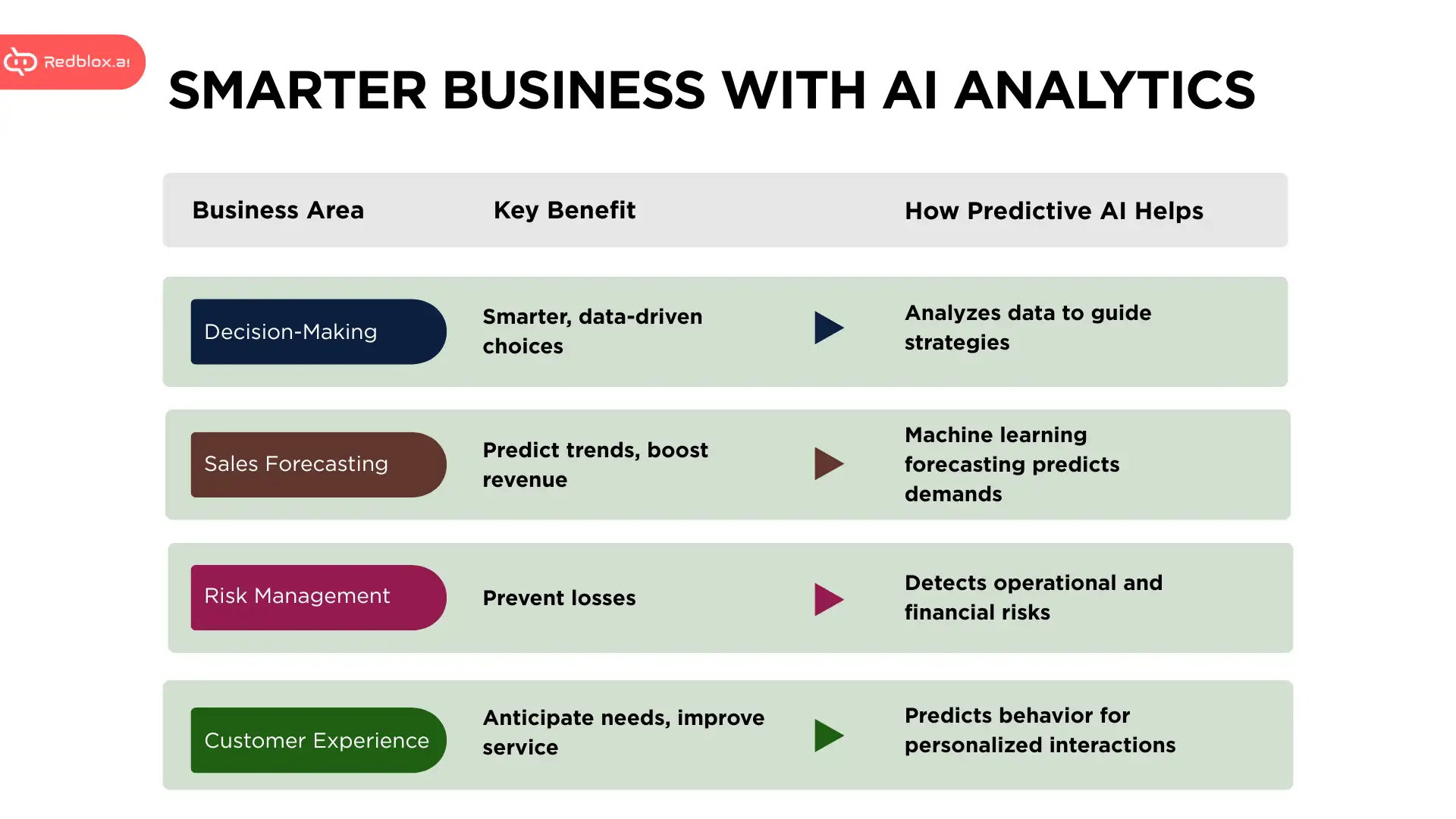
Predictive systems installation is not a technological upgrade but a strategic change that makes the whole business ecosystem stronger.
Key benefits include:
Smarter, Faster Decisions
AI produces information on a real-time basis, meaning that the decision-making process becomes more reliant on data. Research indicates that the decisions made by organizations that employ high-end analytics are 5 times quicker.
Operational Cost Savings
Predictive models assist the companies in getting rid of waste, maximising resources and reducing errors. In most industries, predictive analytics can save operation costs by a quarter.
Larger Customer Experiences
AI predictive analytics will predict customer behavior, enabling businesses to individualize their interactions and preemptively address the needs of customers. The customer engagement increases by 20-30% when the brand utilizes predictive insights.
Improved Risk Management
Forecasting tools reduce the operational harm, ranging between fraud alerts and supply chain vulnerabilities. The speed of AI-based risk models is 90% greater than that of manual risk detection.
Scalable Growth Foundation
The long-term effects of organizations incorporating predictive analytics through AI put them ahead of the other companies. Predictive capabilities lead to a faster growth of the companies by 2 times.
Want to find out how to apply the AI predictive analytics in your organization? Get in touch with us to see how we can help.
Prepare Your Business for Implementation
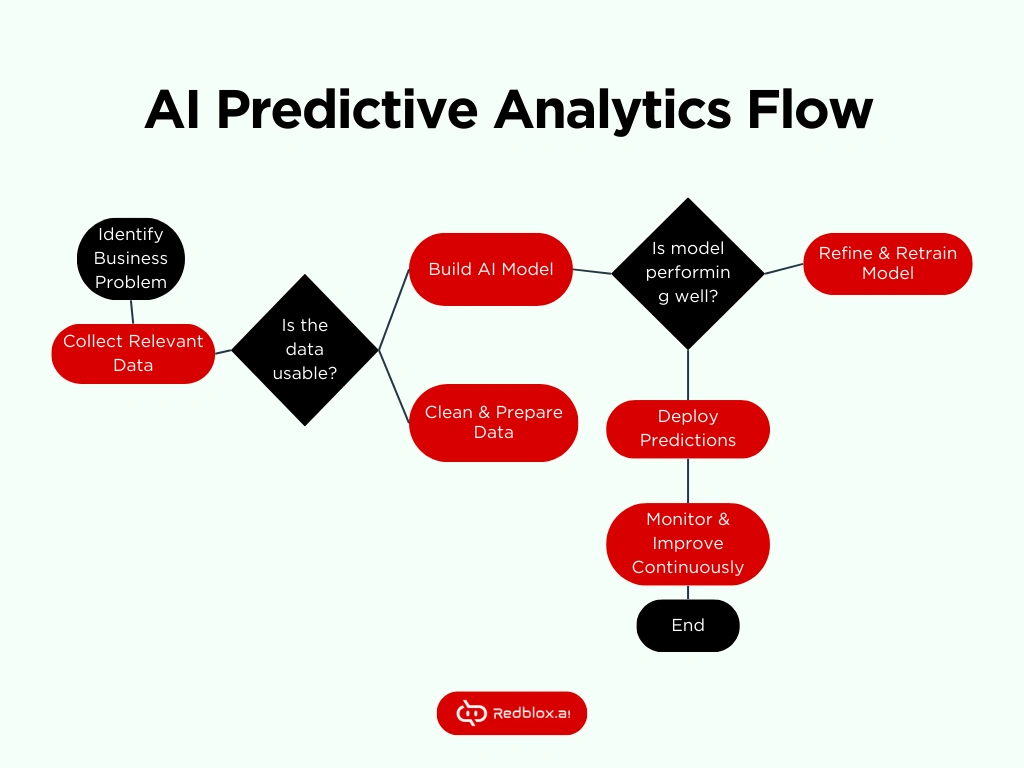
Preparation is important to make it a lot easier.
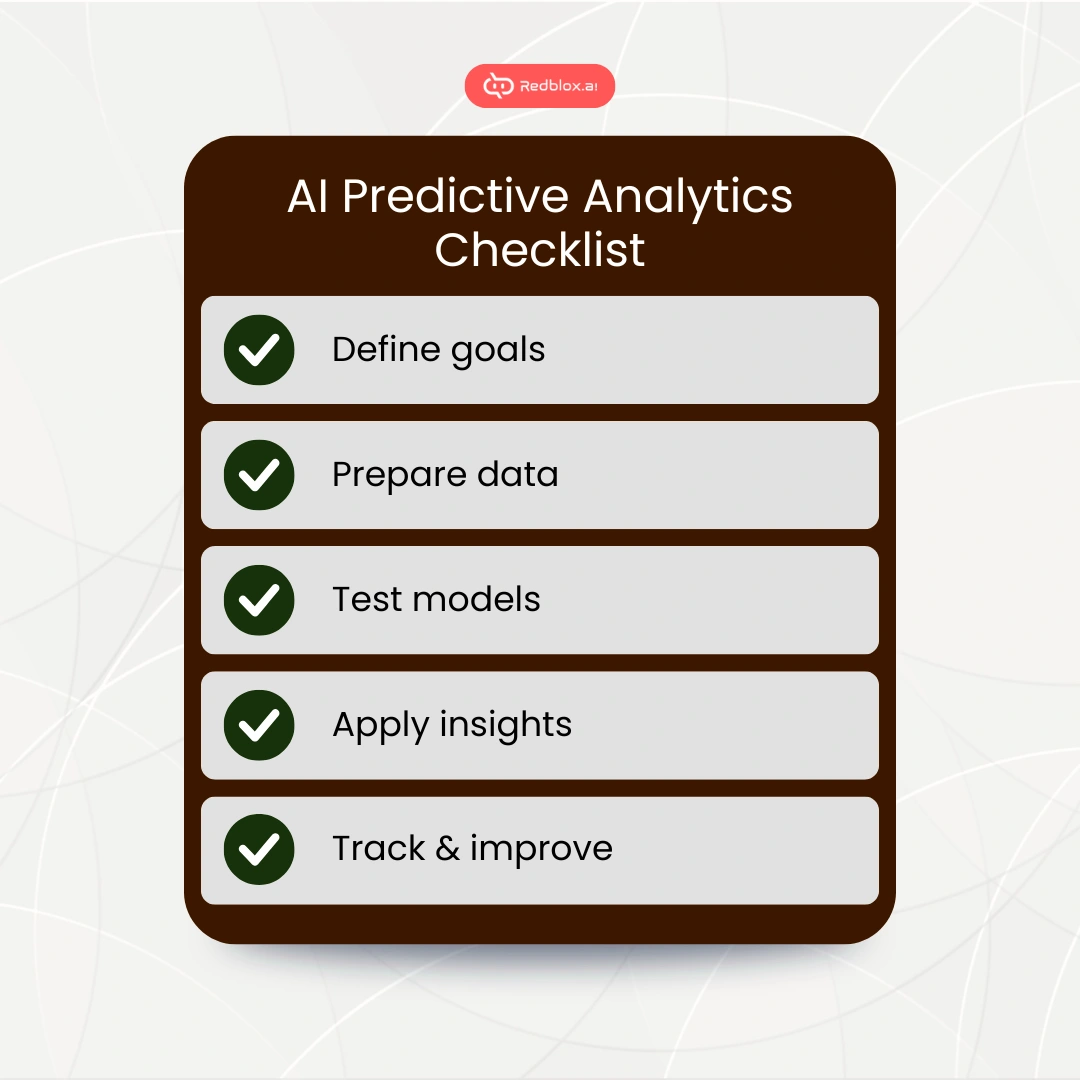
Step 1: Define Your Core Use Cases
Examples:
- Reduce defects
- Enhance accuracy of forecasting
- Optimize inventory
- Strengthen fraud detection
- Predict equipment failures
The whole implementation process is guided by clear goals.
Step 2: Assess Your Data Landscape.
Rather than posing the unprofessional questions, go with a professional assessment framework:
Evaluate the information on the following scales:
- Volume: Is it sufficient to train AI models?
- Quality: To what extent is the data consistent, complete and reliable?
- Relevance: Can the data be related to your use case?
- Form: Is it easy to put into the analytical systems?
Step 3: Align Stakeholders
Invite the aligned teams to the discussion. The common stakeholders are:
- Business strategy leaders
- Data teams
- IT infrastructure teams
- Marketing, sales, or operations (whichever is used).
Step 4: Choose a path of Implementation
Select the path that is appropriate to your resources:
- Establish an internal DSS group
- Predict using no-code/low-code AI
- Outsource to an AI consulting partner
Choose the way that fits your resources, whether to construct a solution internally, use no-code AI platforms, or hire a consulting partner. To be able to better comprehend when it is possible to choose a fully made solution or just a ready-made system, check out our guide on Custom AI Model Development
Collect, Classify, And Organize Your Information
Information drives your predictive machine.
Determine Quality Data Sources
Typical sources include:
- Website behavior records
- POS and transactional data
- Customer journey touchpoints and CRM
- Supply chain and logistics information
- Operation and financial performance indicators
- IoT device and sensor data
Major storage systems used to capture these sources are AWS S3, Google BigQuery and Snowflake
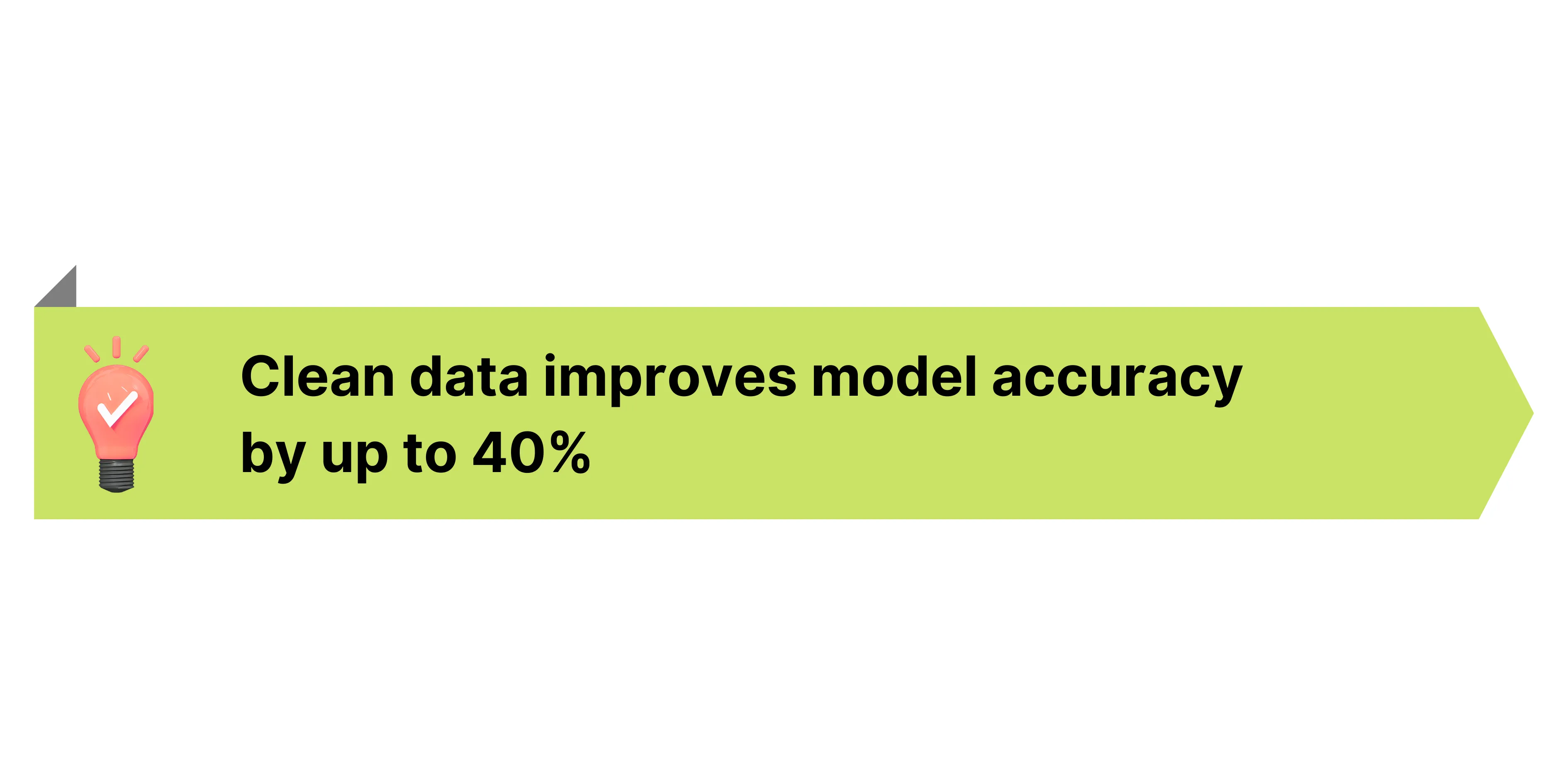
Clean and Organize the Data
Quality is non-negotiable. Focus on:
- Consistency across systems
- Removing duplicates
- Handling missing values
- Standardizing formats
Centralize Your Data
Businesses often use:
- Data warehouses
- Cloud-based data lakes
- Customized analytics systems.
Under this centralization, the AI predictive analytics models can train very well.
Classify Data for AI
Organize your dataset into:
- Training data
- Validation data
- Testing data
This makes sure that your models are trained properly and that they will be reliable when added to the predictive modeling tools.
Select the Right Technology to implement AI
The selection of the appropriate tools is important for scalability in the long run.
Basic Predictive Modeling Instruments
The fundamental systems typically deployed in the contemporary AI world are
- AWS SageMaker
- Google Vertex AI
- Azure ML Studio
These predictive modeling solutions help teams to construct, observe, implement, and respond to AI forecasts with enterprise-level performance.
Cloud Systems and Infrastructure
Cloud platforms support:
- Elastic scaling
- Strong security
- Faster computation
- Easier deployment
- Real-Time Dashboards
Knowledge can only be valuable when it is easily seen by teams.
Security/compliance capabilities
In order to be trusted and in compliance with the rules, make sure your environment provides
- Role-based access
- Encryption standards
- Observe data regulations
- Following significant models like the SOC 2 and ISO 27001
A safe and compliant system enhances the confidence of organizations and facilitates safe and scalable adoption.
Train and Develop AI Predictive Models
This is what the core of the implementation is
- Popular approaches include:
- Regression models
- Time series forecasting
- Classification models
- Artificial intelligence neural networks.
- Decision tree algorithms
The type will be determined by the use case
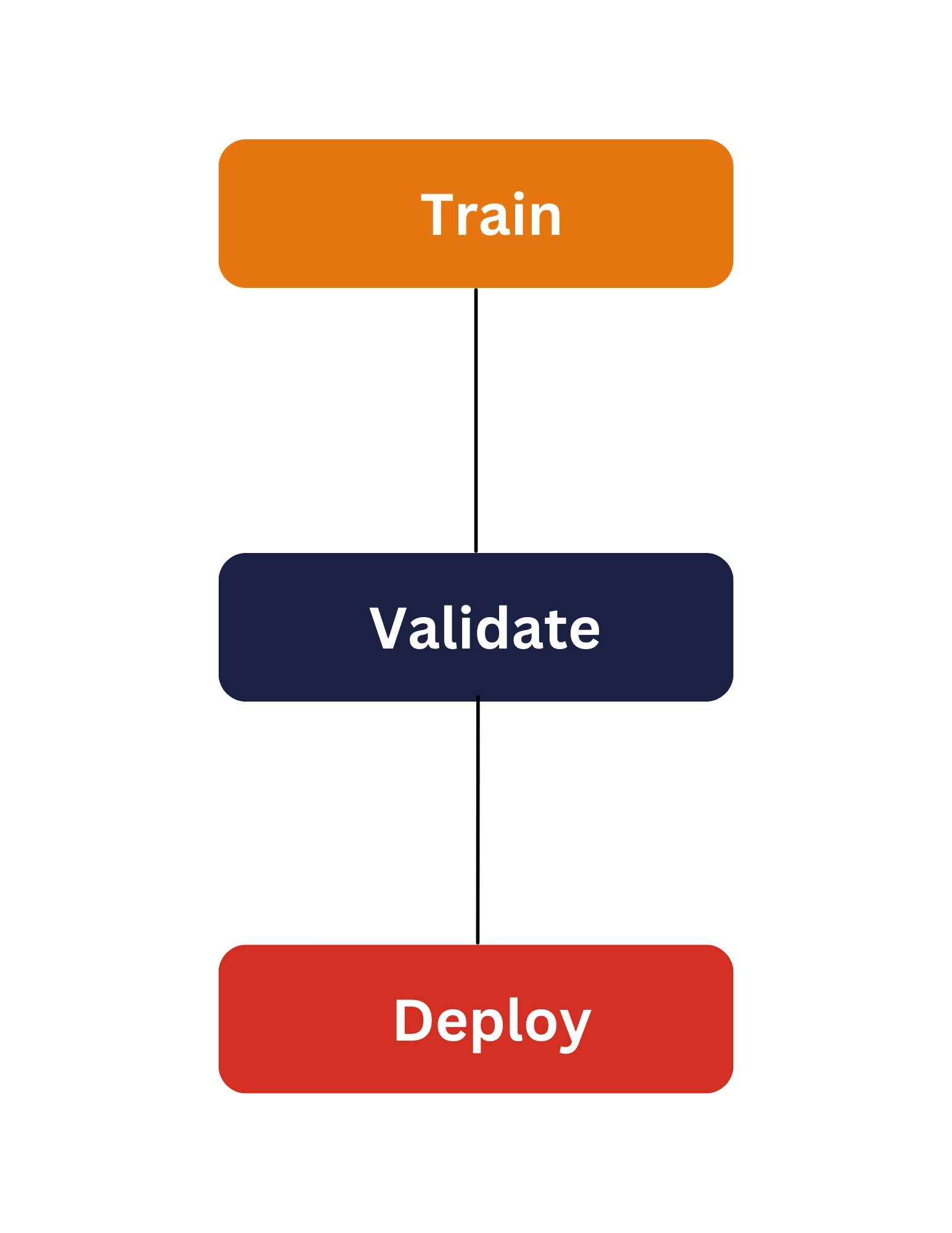
Train Your Model
In the course of training, the AI is taught:
- Patterns
- Tendencies
- Correlations
- Behavioral sequences
This is where machine learning forecasting begins to deliver predictive power
Validate the Model
Key metrics include:
- Precision
- Recall
- F1 score
- Error rates
- Optimize the Model
Accuracy and performance are enhanced by increasing the tuning parameters.
Deploy Your Model
Upon training, deploy your model using APIs or through MLOps pipelines, i.e. MLflow, Kubeflow or AWS SageMaker Pipelines, to make sure your model is delivered with a scalable and reliable production.
Establish an Ongoing Learning Process
There must be no inactivity for AI. Constant updates cause predictions to be smarter with data driven decision making in the long run.
Introduce AI in everyday business
AI will only add value when it is integrated into your workflow.
Predictions can be incorporated into workflow systems in the following ways:
Marketing Automation and CRM
Use predictions for:
- Customer segmentation
- Lead scoring
- Individualized campaign triggers
Inventory and Supply Chain
AI can predict:
- Stockouts
- Demand spikes
- Delivery delays
Finance and Risk
Predictive models enhance:
- Fraud detection
- Credit scoring
- Cash flow forecasting
Operations and Manufacturing
AI helps with:
- Predictive maintenance
- Quality control
- Workflow optimization
Sales and Revenue Budgeting
Predict sales behavior with machine learning forecasting architecture
Construct Governance, Precision Controls and Ethical AI Practices
Responsible AI is essential
Monitor Model Drift
As business environments evolve, AI must adapt. Monitor performance over time using monitoring dashboards.
Assure Ethical Information Practices
Work with a variety of datasets in order to avoid bias and practice fairness.
Deal with Data Privacy Requirements
Follow major regulations:
- GDPR
- CCPA
- Industry standards
Strengthen Data Security
Implement:
- Encryption
- Multi-factor authentication
- Penetration testing
- Access controls
Credible AI is long-term AI.
Measure ROI and Evaluate AI Impact
You cannot measure what you do not improve.
Track Key Metrics
The measurements are dependent on the use case:
Revenue-focused metrics
- Increased sales
- Increased customer lifetime value.
Operational metrics
- Lower costs
- Reduced waste
- Faster cycle times
Measurements of customer experience
- Improved retention
- Higher engagement
- Reduced churn
Compare Before vs. After Implementation
Record performance by time in order to show real ROI.
Expand Use Cases Over Time
It is prudent to start small and scale.
Challenges and the way to overcome them
Blocks are there in every predictive modeling tool. Here's how to stay ahead:
Lack of Data Organization
solution: Build transparent data pipelines and data cleaning.
Resistance to AI Adoption
Solution: Train and show preliminary victories.
Overly Complex Tech Choices
Solution: Have simpler predictive solutions and build up.
Unrealistic Expectations
Solution: Be realistic and set deadlines.
Applications in the real world: The Real Value of Predictive Analytics and AI.
Examples across industries:
Retail
- Personalized recommendations
- Inventory optimization
- Customer disturbance reduction
The retail teams will be able to predict demand spikes more accurately by automating demand-spike prediction, which is actually 12-18%.
Healthcare
- Anticipating the level of risk of the patients
- Scheduling optimization
- Outcomes of treatment planning
Manufacturing
- Predictive maintenance
- Forecasting in production lines
- Automated quality checks
Using predictive maintenance leads to a reduction of downtime by 30% in manufacturing teams.
Finance
- Fraud alerts
- Risk analysis
- Credit predictions
Logistics
- Delivery time predictions
- Fuel efficiency modeling
- Route optimization
These demonstrate how predictive analytics and AI transform the business results.
AI predictive analytics Future Trends
The future is even greater than the present.
Administrative Decision Systems.
AI will not only predict, but they will also make automated decisions.
Hyper-Personal Customer Experiences.
The predictions will become more accurate due to the rich datasets.
Prediction Layers On AI in Real Time
Companies will work with real-time forecasting integrated into all of their workflows.
Cyber-sophisticated predictive modelling tools
No-code and low-code AI will increase access in organizations.
Industry-Specific AI Models
Prediction engines will be replaced with customized models.
Being ahead of these trends will make your competitive advantage stronger.
Conclusion: Get AI Predictive Analytics Started.
One of the strongest moves that you could make is to integrate AI predictive analytics into your business to make smarter decisions, better customer experiences, and grow even quicker.
Are you willing to introduce predictive analytics to your business? RedbloxAI develops AI based forecasting, automation, and decision intelligence. Contact us today.
FAQ
What are the best sectors that AI predictive analytics can serve?
Retail, healthcare, manufacturing, finance, logistics, and e-commerce industries are among the industries that obtain great benefits from AI predictive analytics since it can improve the forecasting process, make decisions automatically, and improve customer experiences.
Is it possible to combine predictive analytics with existing business software?
Yes. Predictive analytics solutions have the ability to achieve workflow alignment with CRM systems, ERP platforms, marketing automation solutions, BI dashboards and cloud data warehouses.
What does the cost of implementing AI predictive analytics cost?
Prices are different depending on the tools, size of the data, and complexity of the project. No-code systems begin at a minimum of monthly products, but higher infrastructure, modeling, and integration costs could be needed in enterprise applications.
Will AI predictive analytics be safe with sensitive business data?
Yes. The current platforms are applied to ensure that sensitive information is secured during the predictive process by employing encryption, role-based access, compliance standards, and secure cloud infrastructure.
Should a data science team be hired to apply predictive analytics and AI?
Not always. A large number of businesses are implementing low-code or automated AI platforms, which make the process of data preparation, modeling and deployment easier. A data team assists in more advanced use cases; however, it is not needed for starting small.
What are the steps to introducing AI predictive analytics in my company?
Start with the definition of a clear existing data environment. Then perform data cleaning and centralization, select the appropriate predictive tools, and create a model that is in accordance with your interests.
Are predictive analytics and AI necessary in small and mid-sized businesses?
Yes. Cloud-based and no-code solutions are now providing predictive analytics and AI to SMBs. They assist in automating decision making, aiding in the demand forecasting.